The Current Stage of AI Usage
It is undeniable that we all use AI with an increasing rate not only for personal use but also in corporation. The statistics collected from top 5 LLMs like ChatGPT, Gemini, Claude, Perplexity and Grok by Graphite below emphasize the importance of AI. AI monthly session is trending strongly upward since 07/2023 toward end of 2025, with worldwide use of AI 7 times larger than use in the United States.

A lot of anonymous online content appears. We even don’t know it is real or not and cannot believe what we perceive blindly. With redundant information that AI gives us, it is more difficult to prove the picture, the social ID, the sound voice, video without using our human oversight.
In 2022, Musk used to tweet that 90% of his comments are bots during his process of buying Twitter. The automated bot in Elon’s comment replicates identity of Binance’s founder, Changpeng Zhao. Zhao also makes funny agreement by answering Elon’s post “I agree. Only this one is real.” These are the perspectives confirmed by these two great world’s mastermind.
Elon Musk further make an argument that social media networks were essentially turning into giant, artificial bot farm. His concerns were tech companies failing to prevent a highly advanced, bad super-intelligence from “Escaping into the internet. This is undeniably true in today’s world.
The Negative Impact of Excessive Use of AI
Back to 2006, there is a famous phrase by british mathematician, Clive Humby that
Data is the new Oil.
This statement is falsifiable in today’s age of AI, when verified data is more important.
As such, in today’s world, the marginal cost of producting information is very low compared to the past. AI get much smarter and cost cheaper. The result is something terrifying. Artificial Intelligence could generate flood of unverifiable and fake information with respect to video, voices, images, news, experts or even financial reports. It is our responsibility to re-check these data. The question is Can we believe what we are seeing right now? In the next decade, information scarcity is not a problem, it is trust scarcity.
In this trust crisis world, AI is the technology that is responsible. Truth competes with lies. Expertise competes with Imitation. Authenticity competes with fabrication. This in turn creates an Economic Friction. Productivity is lower since businesses, government, investors and citizens act slowly and hesitantly. They are unsure of whether information they are consuming is real or not.
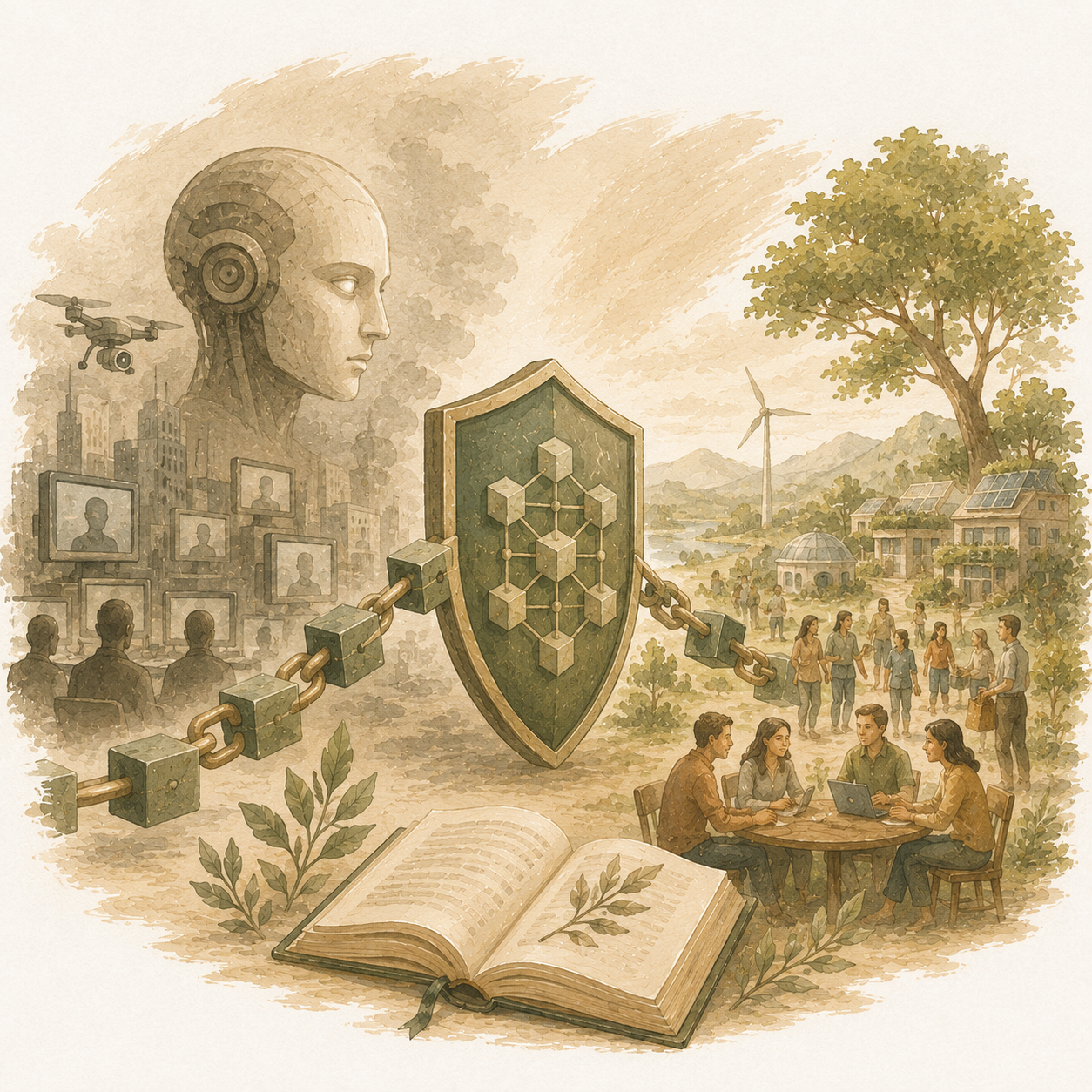
Will AI leads to Utopian or Dystopian Future?
This section will explore the possibilities of utopian and dystopia future that several experts argue and ask for your actions!
Utopian Future VIEW
Marc Andreessen, Netscape founder and famous venture capitalist, published essay in favor of AI titled “Why AI Will Save the World”. He argues that AI magnifies human intelligence. This drives human quality of life and human’s well-being to be better.
Dystopian Future VIEW
Yuval Noah Harari, famous best-selling author “Sapiens“, argues that while technology gives humanity immense power to manipulate our environment, it hasn’t made us any better or happier.
“We are much more powerful than our ancestors, but it is not at all clear that we are much happier.”
Tristan Harris, ex-Google Insider and AI Expert, also warns uncontrollable AI will blackmail humans, hack democracy, and threaten jobs by 2027 when he get interview in The Diary of CEO channel. He reveals how ChatGPT, China, and Elon Musk are racing to build uncontrollable AI. You can listen to more detail Here
My Perspective on Utopian and Dystopian Future that AI will lead
We can achieve utopian future by imposing universally “good” framework about how AI is used in different fields of study. Turn back in time, we found an evidence of framework in Babylon. In ancient babylonian times, 282 written laws legal Code of Hammurabi contributes mostly for Babylonian’s wealth success in the past. An appropriate framework is a must to keep society functions well.
If people use AI with no framework or in a decentralized AI, people by its nature could drive AI in harmfulway. This could hurt other human or business mentally or physically. This path leads to dystopian. The question is the extent of how related authorities or controlling entities in the world impose a rule on AI usage. Since AI model weight answer on user’s input, any individual could trick Artificial Intelligence to do something dishonestly.
Government’s Effort to Deal With Fake Media
The European Union will enforce EU AI Act in August 2026. The regulation requires clearly labeling AI-generated or altered media so that users know data is synthetic or not. US Federal laws also impose Take It Down Act to criminalize creator of those who generate AI image for intimidation purpose, forcing media platforms to remove within 48 hours. Furthermore, China enforces regulation to prevent anonymous AI misuse. Every platforms are legally obligated to embed digital watermarks into AI media and must be able to track content back to its creator.
Government’s effort to deal with fake media seems uncontrollable. This happens around the world. Artificial Intelligence’s technology evolves exponentially. By the time a bill like the EU AI Act goes from draft to full enforcement, the underlying AI technology has already completely changed. It shifts from simple text models to automous multi-agent systems.
There are still several issues that invalidate government’s action. Regulation imposed by each country’s government has border, but AI has no borders. Developers can simply shift operations to regions with looser AI framework. The other issue is developers can download and modify open-source AI models in their personal hardward anywhere in the world and adjust to their misuse purposes. Once these developers released open-source, government cannot recall it.
We should not depend on government’s actions only. There should be more ways to cope with fake media. This could lie in another technology which can discourage the misuse of AI. Since Trust is what AI scarces, we must use technology that can validate in trustless environment. That is Blockchain
Alternative Solution
What is Blockchain?
According to IBM, Blockchain is a shared, immutable digital ledger, enabling the recording of transactions and the tracking of assets within a business network and providing a single source of truth. In other words, Blockchain uses a network of independent computers to agree on a single, unchangeable version of facts using cryptography. The data on blockchain is 100% verified and permanent. If you are wondering how it works, below is a diagram from investing.com that is easy to catch up the concept.

Because blockchain has properties of immutable ledger and decentralization, blockchain together with AI can improve AI’s data transparency and security.
Blockchain does not solve intelligence as AI does, but it solve verification. AI can create content while blockchain proves provenance. If significant data in our economy is recorded on blockchain, this can prove verification. For example, everytime scientific research is recorded on blockchain, there is a cryptographic proof that people in blockchain could verify. Blockchain expands transparency into several fields such as
- Educational certificates
- Government records i.e. Birth Certificate, Marriage Certificate
- Property Ownership
- Supply Chains
- Financial Transactions
Key Challenges of using Blockchain
Both AI and Blockchain consume amount of resource. This could create compounding energy crisis. Modern artificial intelligence requires thousands of specialized computer chips working at maximum capacity. This process consumes immense amount of power and require even more energy to keep the data centers cool. If we try to constantly double check, log and agree on every minor adjustment using blockchain, a network of computers around the world must run complex math problems to verify data and update on ledger. This is notoriously high energy consumption.
Furthermore, AI models are “Black boxes” with unknown connections. Human cannot find specific conclusion on why AI answer in that way. This is loophole for “Agent” in Principal Agent Problem. A principal, a public smart contract, demands a safe, honest and transparent AI. An agent, computer operator or node, however could tweak the AI model to give biased asnwers or spread fake media. Precisely, an agent could use clever coding to trick blockchain ledger into thinking that AI behaved perfectly.
The World using Blockchain
If energy bottleneck is not the main factor that prevent full stream of blockchain adoption, what will the world be?
The world without blockchain but only ai
First, let us imagine the world with widespread adoption of AI usage but low adoption of blockchain technology. AI gives us a lower marginal cost of produce information. This leads to lower cost of creation of new product or services. Due to low barrier to entry in any industry, it means that more and more product and services are produced. This gives rise to more unreliable or questionable products and services’ quality.
Human cannot validate by themselves. They must seek centralized authorities or research center, but what if these entities are corrupted. What if research center use biased AI-driven data to help validate product’s quality. Furthermore, how can we ensure that the product and services really serve what we need. Even if we can personalized our nutrition to match our cracked DNA, how can we make sure the nutrition from agriculture or manufacturing in factory the same as another factory. There are several questions rising in terms of transparency.
the world with blockchain and ai
As such if we adopt blockchain, we can record all important nodes in which our community consider issues. Using decentralized distributed ledger of blockchain, we can ensure to some degree that our food, water and resources are clean. This leads to overall increase in human quality of life. For business sector, a business that adopt blockchain will be likely to earn more customer’s trust from its integrity.
AI Agent Economy wil be a lot larger and more versatile. AI agents can use blockchain to safely pay each other through Smart Contracts without needing a human bank account. Using smart contracts, self-executing code on blockchain, contract might say: “If Agent A delivers the verified data set or does some financial report work, Agent B’s wallet automatically releases the payment to Agent A’s wallet”. Neither Agent A or Agent B can cheat each other. In DePIN (Decentralized Physical Infrastructure Networks), agents could independently buy raw computational power, storage and energy from decentralized infrastructure networks based on real-time market prices.
For other cases that blockchain could improve include:
- AI doctors recommend something that can be auditable
- AI financial advisors with transparent reasoning and tracking record
- Government’s spending in real time
- Every donation for charity is traceable
- Every ingredient in food system can be verified, from farm to table.
Additional Sources used:
Explodingtopics